
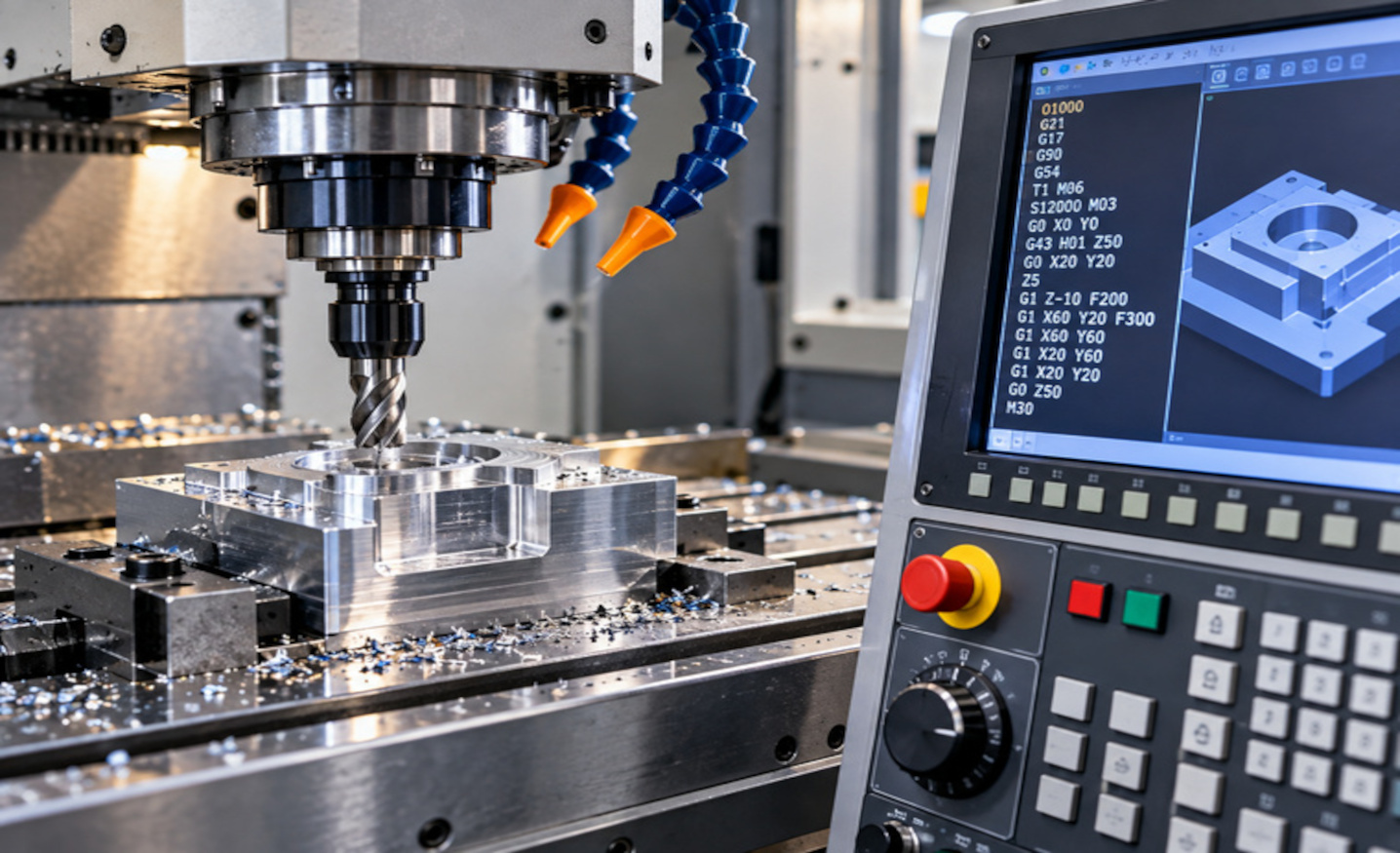
Description
CNC Programming and Operations
Welcome to the CNC Programming and Operations course.
Computer Numerical Control, or CNC, is a fundamental technology used in modern
manufacturing. CNC machines allow components to be manufactured accurately, consistently
and efficiently by controlling machine movements through programmed instructions.
In this course, we will introduce you to the principles of CNC technology, examine the
components and operation of CNC machines, and develop your understanding of CNC
tooling, work holding and programming.
You will also work through a series of practical CNC programming examples for both
milling machines and CNC lathes.
The course is divided into seven lessons.
Let us begin by looking at what you will cover in each lesson.
Lesson 1 – Introduction to CNC Technology
In Lesson 1, we begin with an introduction to CNC technology.
We will look at what CNC machining is and how it is used in modern manufacturing.
We will explore the historical background and evolution of CNC, considering how
machining technology has developed from conventional machine tools to today’s computer-
controlled systems.
We will then examine the different types of CNC machines and their applications.
Finally, we will consider the advantages and limitations of CNC machining.
By the end of this lesson, you will have a foundation in CNC technology and an
understanding of why CNC machines are so widely used in manufacturing.
Lesson 2 – CNC Machine Components and Operations
In Lesson 2, we move on to the CNC machine itself.
We begin by examining the basic components of a CNC machine and the function of these
components.We will then look at the operating principles of CNC machines and how programmed
instructions are converted into controlled machine movements.
An important part of CNC operation is setting up the machine correctly.
Therefore, we will also examine machine setup procedures, including workpiece mounting,
tool loading and general machine setup.
Understanding these procedures is essential because accurate machining depends not only on
the CNC program, but also on correct machine preparation and setup.
Lesson 3 – CNC Milling Tooling and Work Holding
Lesson 3 focuses on CNC milling tooling and work holding.
We will examine the tooling used during CNC milling operations and consider how tools are
selected for different machining requirements.
We will also look at methods of securing and supporting the workpiece during machining.
Correct tooling and work holding are essential for producing accurate components and for
ensuring that the workpiece remains secure during machining operations.
Lesson 4 – CNC Turning Tooling and Work Holding
In Lesson 4, we move from milling to CNC turning.
We will examine the tooling used on CNC lathes and consider how different tools are used
for different turning operations.
We will also look at work holding and how components are securely mounted on a CNC
lathe.
As with milling, correct tooling and work holding are fundamental to achieving safe, accurate
and repeatable machining results.
Lesson 5 – CNC Programming Basics
In Lesson 5, we begin to look at CNC programming.
We start with an introduction to the two fundamental CNC programming languages used
throughout this course: G-Code and M-Code.We will examine the structure and syntax of G-Code commands and develop an
understanding of how individual commands control machine movements and functions.
We will then move on to writing simple G-Code programs for basic machining operations.
Finally, we will introduce CAM, or Computer-Aided Manufacturing, software and
examine its role in CNC programming.
CAM software can be used to assist with the development of CNC programs by converting
component geometry and machining requirements into machine instructions.
By the end of this lesson, you will have established the basic programming knowledge
needed for the worked examples that follow.
Lesson 6 – Programming CNC Mills: Worked Examples
Lesson 6 is focused on programming CNC milling machines through a series of worked
examples.
We begin with simple machine positioning and then progress to linear cutting operations.
We will develop a program for machining a rectangular profile.
Next, we will use a drilling canned cycle to produce a four-hole pattern.
We will then examine peck drilling for producing a deeper hole.
After this, we will introduce circular interpolation using G02.
As the lesson progresses, we will combine several machining operations to produce a
complete component.
Finally, we will look at absolute and incremental programming and introduce cutter
compensation.
These worked examples will allow you to see how individual CNC commands can be
combined to create complete machining programs.
Lesson 7 – Programming CNC Lathes: Worked Examples
In Lesson 7, we move on to programming CNC lathes.
For each example, we will first examine the component drawing.We will then identify the required machine movements, develop the appropriate toolpath and
write the corresponding G-Code program.
We will work through a range of common CNC lathe operations.
These include:
Basic facing.
Straight turning.
Step turning.
Taper turning.
Drilling.
Grooving.
And threading.
Finally, we will bring several techniques together to produce a complete turned component
using roughing and finishing cycles.
This final lesson will help you develop a more complete understanding of how CNC lathe
programs are created from engineering drawings and machining requirements.
Course Summary
Throughout this course, we will progress from the fundamentals of CNC technology to the
practical development of CNC programs.
We will begin by understanding CNC machines, their components and their applications.
We will then examine tooling, work holding and machine setup for both milling and turning.
Next, we will develop our understanding of G-Code, M-Code and the basic principles of
CNC programming.
Finally, we will apply this knowledge through a series of worked examples for both CNC
mills and CNC lathes.
By completing these lessons, you will have developed a structured understanding of CNC
programming and operations, from the basic principles through to the development of
programs for complete components.
Let us now begin with Lesson 1 – Introduction to CNC Technology.




Reviews
There are no reviews yet.