
Introduction
Copper cabling remains an important medium for the transmission of voice, data and other communication signals within buildings. To install and maintain copper communication systems effectively, it is important to understand both the electrical principles behind signal transmission and the practical requirements for installing, terminating and testing cabling systems.
In this course, we will examine the fundamentals of electricity and signalling, structured cabling systems, cable types, installation practices, termination methods and the testing and documentation required to verify an installation.
The course is divided into four lessons.
Lesson 1 – Electrical Theory
In Lesson 1, we begin with the electrical theory required to understand copper communication systems.
We will look at how electricity flows through conductors and examine the basic electrical quantities of voltage, current and resistance.
You will learn how to apply Ohm’s Law to calculate voltage, current and resistance, and how electrical power is calculated.
The lesson will also introduce series and parallel circuits, alternating and direct current, and the relationship between electricity and magnetism.
We will examine Maxwell’s corkscrew rule and consider how electromagnetic fields can affect communication circuits and create unwanted electrical noise.
The lesson then introduces important concepts including capacitance, inductance, impedance and characteristic impedance.
Finally, we will look at electrical symbols, signalling systems and the differences between analogue and digital signals. We will also explain terms such as Megahertz and Megabits per second, and introduce terminology used when describing the transmission performance of communication cabling. Copper Communications Cabling -…
By the end of this lesson, you will have the electrical foundation needed to understand how signals behave when transmitted over copper cabling.
Lesson 2 – Installation
Lesson 2 focuses on the installation of copper communications cabling.
We begin by considering why good installation practice is essential. As data transmission speeds increase, poor installation practices can result in interference, signal degradation and network performance problems.
We will examine common installation problems, including routing communication cables too close to power cables, excessive untwisting of cable pairs, damage to insulation, exceeding the minimum bend radius and excessive tightening of cable ties. Copper Communications Cabling -…
You will then learn about network topologies, including bus, ring and star configurations.
The lesson introduces structured cabling and the specifications associated with structured cabling installations, including American, international and European specifications.
We will examine the principles of horizontal cabling and backbone cabling, as well as permanent links and channels.
The course then looks at open-office cabling arrangements, including Multi-user Telecommunications Outlet Assemblies, or MUTOAs, and Consolidation Points.
You will also be introduced to the different types of cabling and equipment used in communication installations, including:
- Twisted-pair cables
- Unshielded Twisted Pair, or UTP
- Shielded Twisted Pair, or STP
- Foil Twisted Pair, or FTP
- Fibre optic cables
- Cabinets and associated equipment
The lesson continues with practical cable installation requirements, including bend radius, cable containment and the control of electrical noise.
We will also consider installation planning and practices within buildings, voice cabling and the CW1308 cable colour code.
By the end of this lesson, you will understand the key principles involved in planning and installing a copper communications cabling system.
Lesson 3 – Termination of Copper Cabling
Lesson 3 focuses on the termination of copper cabling.
Correct termination is critical because the performance of a communication cabling system depends heavily on the quality of the installation and the termination of the individual cable pairs.
We will introduce the TIA/EIA 568 wiring schemes, including T568A and T568B, and examine how these schemes are used when terminating structured cabling.
You will learn about the preparation and termination of Category 5 and Category 6 patch leads, as well as the termination of multicore cabling into block wiring systems.
The lesson also covers the termination of copper cabling for telephone systems.
Particular attention is given to termination practices that can affect cable performance. These include protecting the conductor insulation, maintaining the correct pair twists and keeping the cable sheath as close as possible to the termination point.
We will also examine labelling, patching and the importance of maintaining the integrity of the cabling system after termination. Copper Communications Cabling -…
By the end of this lesson, you will understand how copper communication cables are prepared, terminated and finished correctly.
Lesson 4 – Testing and Documentation
The final lesson focuses on testing and documentation.
Testing is an essential part of the structured cabling installation process because it verifies that the installed system is capable of meeting the required transmission performance.
You will learn why cabling installations must be tested and how testing standards are applied.
The lesson introduces continuity testing and the use of testing equipment to identify problems within the cabling.
We will then examine certification testing and the measurement of important cable-performance parameters.
These include:
- Wire mapping and continuity
- Cable length
- Insertion loss or attenuation
- Near End Crosstalk, or NEXT
- Propagation-related measurements
- Other parameters required for certification
The lesson also explains how test results should be recorded and documented.
You will learn about the information that should be retained for each tested link, including the link identification, Pass/Fail result, selected test standard, cable type, tester identification and test date and time. Copper Communications Cabling -…
By the end of the lesson, you will understand how to test a copper cabling installation and how to produce appropriate documentation to demonstrate that the installation has been tested successfully.
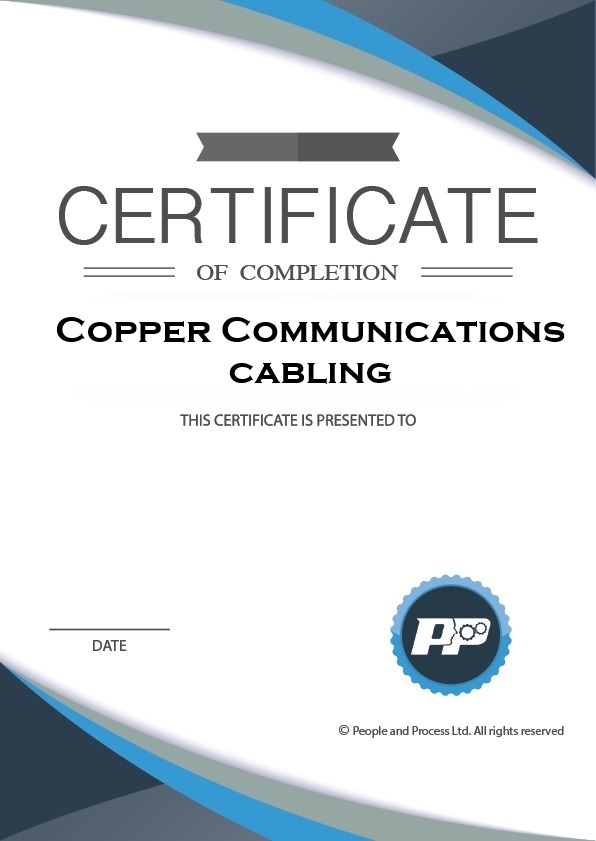
On successful completion of this course all students will be awarded a Certificate of
Completion. This certificate confirms you have completed all the video lessons for
every module and fully met all the requirements of the course.
To achieve this award all the assessment quizzes for each lesson must be passed. The pass grade for each quiz is 80%.You can retake lesson quizzes as often as you like.
The Assessment Method
There’s a quiz at the end of each lesson to test your understanding of the material. To successfully complete this course, you must pass the quiz for each lesson. Once all the lessons have been completed, you can then download and print the People & Process completion certificate.
So let’s get started! In the next lesson entitled “The Need for Good Food Hygiene “, we will look at the requirement for good hygiene practices and how these are implemented.
