
Welcome to the Medical Device Manufacturing Fundamentals course.
Medical devices play a vital role in modern healthcare, supporting the diagnosis, monitoring, treatment and prevention of medical conditions.
From surgical instruments and diagnostic equipment to implants, medical electronics and advanced monitoring systems, medical devices are manufactured using highly specialised processes that require precision, quality control and strict regulatory compliance.
This course will introduce you to the fundamental principles, technologies and practices involved in medical device manufacturing, providing you with an understanding of how safe, reliable and high-quality medical devices are produced.
Course Aim
The aim of this course is to provide you with the knowledge and understanding of the key processes, technologies, quality systems and regulatory requirements associated with medical device manufacturing.
Throughout the course, you will explore the different stages of manufacturing, from raw material selection and component production through to assembly, inspection, sterilisation, packaging and final product release.
You will also develop an understanding of the importance of quality management, contamination control, process validation, risk management and continuous improvement in ensuring that medical devices meet the required standards for safety, performance and reliability.
Lesson 1 : Introduction to the Medical Device Industry
In Lesson 1, we will introduce the medical device industry and examine the different types of medical devices used in healthcare.
You will learn how medical devices are classified according to their intended purpose and associated risk, and explore examples of devices used in diagnostics, monitoring, treatment and surgery.
We will also examine the medical device product lifecycle, from initial design and development through to manufacturing, distribution and post-market monitoring.
Finally, we will look at the key roles and responsibilities within a medical device manufacturing organisation and the importance of maintaining high standards throughout the production process.
Lesson 2 Regulatory Requirements and Standards
Medical device manufacturing is a highly regulated industry, where product safety, quality and performance are essential.
In Lesson 2, we will explore the regulatory framework governing medical device manufacturing, with particular emphasis on the European Union’s Medical Device Regulation and In Vitro Diagnostic Medical Device Regulation.
You will be introduced to ISO 13485, the international standard for quality management systems in the medical device industry, and examine the principles of Good Manufacturing Practice.
We will also look at CE marking, conformity assessment, technical documentation and the role of regulatory bodies in ensuring that medical devices meet the applicable regulatory requirements.
Lesson 3 Medical Device Manufacturing Processes
In Lesson 3, we will examine the manufacturing technologies and processes used to produce medical devices and their components.
These include injection moulding, precision machining, extrusion, electronics assembly, adhesive bonding, welding and automated assembly.
You will learn how different manufacturing methods are selected according to the materials, design specifications and intended function of the device.
We will also explore the use of automation, robotics and advanced manufacturing technologies to improve production efficiency, consistency and product quality.
Leson 4 Cleanroom Technology and Contamination Control
Many medical devices are manufactured in controlled environments to minimise the risk of contamination and protect product quality.
In Lesson 4, we will explore the principles of cleanroom technology, including cleanroom classifications, air filtration, environmental monitoring and contamination control.
You will learn about common sources of particulate, microbial and chemical contamination, as well as the importance of personnel hygiene, gowning procedures, cleaning and disinfection.
We will also examine how the movement of personnel, materials and equipment is controlled within cleanroom environments to maintain the required conditions for manufacturing.
Lesson 5: Quality Management Systems
Quality management is fundamental to medical device manufacturing, ensuring that products consistently meet defined specifications and regulatory requirements.
In Lesson 5, we will examine the structure and principles of a quality management system, with a focus on ISO 13485.
You will learn about document control, standard operating procedures, training records, supplier management, internal audits and quality records.
We will also explore non-conformance management, Corrective and Preventive Actions, commonly known as CAPA, and the role of continuous improvement in maintaining an effective quality management system.
Lesson 6 : Quality Control, Inspection and Testing
Quality control involves monitoring and verifying that materials, components and finished products meet their specified requirements.
In Lesson 6, we will explore the different inspection and testing activities carried out during medical device manufacturing.
These include incoming material inspection, in-process quality checks, dimensional measurement, visual inspection, functional testing and final product inspection.
You will also be introduced to Statistical Process Control, sampling methods, acceptance criteria and the identification and management of defective products.
The lesson will demonstrate how effective inspection and testing help identify manufacturing problems and prevent non-conforming products from progressing through the production process.
Lesson 7: Process Validation and Equipment Qualification
Medical device manufacturers must demonstrate that their manufacturing processes are capable of consistently producing products that meet specified requirements.
In Lesson 7, we will examine the principles of process validation and equipment qualification.
You will be introduced to Installation Qualification, Operational Qualification and Performance Qualification, commonly referred to as IQ, OQ and PQ.
We will explore equipment calibration, automated process validation, cleaning validation and the importance of maintaining appropriate validation records.
You will also learn about change control, revalidation and the role of validation in ensuring that manufacturing processes remain reliable and consistent.
Lesson 8: Risk Management in Medical Device Manufacturing
Risk management is an essential part of ensuring the safety and reliability of medical devices.
In Lesson 8, we will explore the principles of risk management and the application of ISO 14971 to medical devices.
You will learn how to identify potential hazards, assess risks, implement control measures and evaluate residual risks.
We will also introduce Failure Mode and Effects Analysis, or FMEA, as a structured method of identifying potential manufacturing failures and evaluating their consequences.
The lesson will demonstrate how risk management is applied throughout the product lifecycle, from design and manufacturing through to product use and post-market monitoring.
Lesson 9: Sterilisation and Microbiological Control
For medical devices intended to be supplied sterile, sterilisation and microbiological control are critical to patient safety.
In Lesson 9, we will examine the principles of sterilisation and the different sterilisation methods used in the medical device industry.
These include steam sterilisation, ethylene oxide sterilisation, gamma radiation and electron beam sterilisation.
You will also learn about bioburden, microbiological monitoring, aseptic processing and sterilisation validation.
The lesson will explain the importance of selecting an appropriate sterilisation method and maintaining validated processes to ensure that the required sterility assurance is achieved.
Lesson 10: Medical Device Packaging, Labelling and Traceability
Packaging plays an important role in protecting medical devices during storage, handling and transportation, and in maintaining sterility where required.
In Lesson 10, we will explore packaging materials, packaging technologies, sterile barrier systems and packaging validation.
You will also learn about product labelling, instructions for use, Unique Device Identification, commonly known as UDI, and the importance of product and batch traceability.
We will examine how packaging integrity, accurate labelling and effective traceability systems support product safety, regulatory compliance and the investigation of quality issues.
Lesson 11: Production Planning, Lean Manufacturing and Continuous Improvement
Efficient production planning and continuous improvement are important in maintaining productivity, controlling costs and ensuring consistent product quality.
In Lesson 11, we will explore the principles of production planning, scheduling, inventory control and resource management.
You will be introduced to Lean Manufacturing principles, including 5S, waste reduction, standard work and visual management.
We will also examine key performance indicators such as Overall Equipment Effectiveness, or OEE, and explore how root cause analysis, Kaizen and continuous improvement techniques can be applied to manufacturing operations.
Throughout this lesson, we will consider the importance of improving efficiency while maintaining the quality and regulatory controls required in medical device manufacturing.
Lesson 12: Product Release and Post-Market Surveillance
The final lesson examines the activities required to ensure that manufactured medical devices are appropriately reviewed, released and monitored throughout their lifecycle.
You will learn about batch record review, final product acceptance, product release documentation and the management of manufacturing deviations.
We will also explore post-market surveillance, customer complaints, vigilance reporting, product recalls and field safety corrective actions.
The lesson will conclude with a case study examining a manufacturing defect, demonstrating how quality investigations, corrective actions, traceability and regulatory requirements work together to protect patient safety and maintain product compliance.
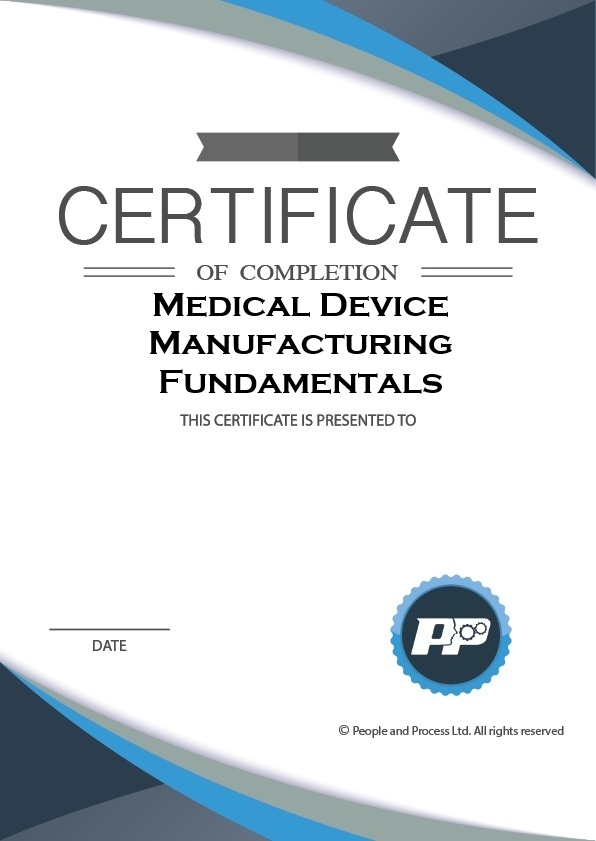
On successful completion of this course all students will be awarded a Certificate of
Completion. This certificate confirms you have completed all the video lessons for
every module and fully met all the requirements of the course.
To achieve this award all the assessment quizzes for each lesson must be passed. The pass grade for each quiz is 80%.You can retake lesson quizzes as often as you like.
The Assessment Method
There’s a quiz at the end of each lesson to test your understanding of the material. To successfully complete this course, you must pass the quiz for each lesson. Once all the lessons have been completed, you can then download and print the People & Process completion certificate.
So let’s get started! In the next lesson entitled “The Need for Good Food Hygiene “, we will look at the requirement for good hygiene practices and how these are implemented.
