
Welcome to the Industrial Robotics course.
Industrial robots have become an essential part of modern manufacturing, helping organisations improve productivity, increase consistency, enhance product quality and carry out tasks that may be repetitive, physically demanding or hazardous for human workers.
From automotive assembly lines and electronics manufacturing to food processing, pharmaceutical production and logistics, industrial robots are transforming how products are manufactured, handled and delivered.
This course will introduce you to the fundamental principles of industrial robotics, the technologies involved and how robotic systems are programmed, operated and integrated into industrial processes.
By the end of this course, you will have a practical understanding of industrial robotics and how these systems can be applied in manufacturing and other industrial environments.
Lesson 1: Introduction to Robotics
In Lesson 1, we will explore the development of robotics and the role industrial robots play in modern manufacturing.
We will examine what defines an industrial robot, how robotic automation has evolved and the key benefits of using robots in industrial operations.
We will also consider the limitations of robotic automation and the factors organisations need to assess when deciding whether to introduce robotics into their processes.
Lesson 2: Types and Configurations of Industrial Robots
In Lesson 2, we will examine the different types and configurations of industrial robots.
We will explore articulated robots, SCARA robots, Cartesian robots, cylindrical robots, delta robots and collaborative robots.
You will learn how these configurations differ in terms of movement, working envelope, payload capacity, speed and accuracy, and how they are suited to different industrial applications.
Lesson 3: Components of an Industrial Robotic System
Lesson 3 focuses on the main components that make up an industrial robotic system.
We will examine the robot arm, joints, actuators, drive systems, controllers, teach pendants and power supplies.
We will also explore how these components work together to provide controlled and accurate movement, and how the robot interacts with other equipment within an automated production environment.
Lesson 4: Robot Coordinate Systems, Work Envelopes and Movement
In Lesson 4, we will explore how industrial robots understand position and movement.
We will introduce robot coordinate systems, including joint, Cartesian, tool and work-object coordinates.
You will learn about robot work envelopes, axes of movement, positioning and orientation, and how these concepts are used to define robot paths and positions within a working environment.
Lesson 5: Industrial Robot Programming Methods
Lesson 5 introduces the main methods used to program industrial robots.
We will examine teach-pendant programming, lead-through programming, offline programming and programming using simulation software.
You will learn how robot positions, movement commands, speeds, paths and input/output signals are used to create robot programmes.
We will also consider how programmes are tested, adjusted and validated before being used in production.
Lesson 6: Robot Sensors, Vision Systems and Feedback Control
In Lesson 6, we will explore the sensors and feedback systems that enable industrial robots to operate with greater accuracy and adaptability.
We will examine position, proximity, force, torque and safety sensors, along with the use of machine vision systems for identifying, locating and inspecting objects.
You will learn how feedback control enables a robot to monitor its movement and respond to changing conditions, and how sensors and vision systems can be integrated with robot controllers and programmable logic controllers.
Lesson 7: Robot End Effectors, Grippers and Tooling
Lesson 7 focuses on the equipment fitted to the end of a robot arm to enable it to carry out specific tasks.
We will examine mechanical grippers, vacuum grippers, magnetic grippers and adaptive grippers, as well as specialised tools used for welding, painting, cutting, polishing and dispensing.
You will learn about tool centre points, payload considerations, grip force, tool selection and automatic tool-changing systems.
We will also consider how end effectors are maintained and how they are selected for different industrial applications.
Lesson 8: Industrial Robot Applications and System Integration
In Lesson 8, we will examine how industrial robots are used in real-world manufacturing and industrial environments.
We will explore applications such as material handling, palletising, machine tending, assembly, welding, painting, packaging and quality inspection.
We will also examine how robots are integrated with conveyors, sensors, programmable logic controllers, manufacturing equipment and production management systems.
Through practical examples, we will consider the key factors involved in designing and implementing an integrated robotic cell, including production requirements, equipment coordination, operational efficiency and safety.
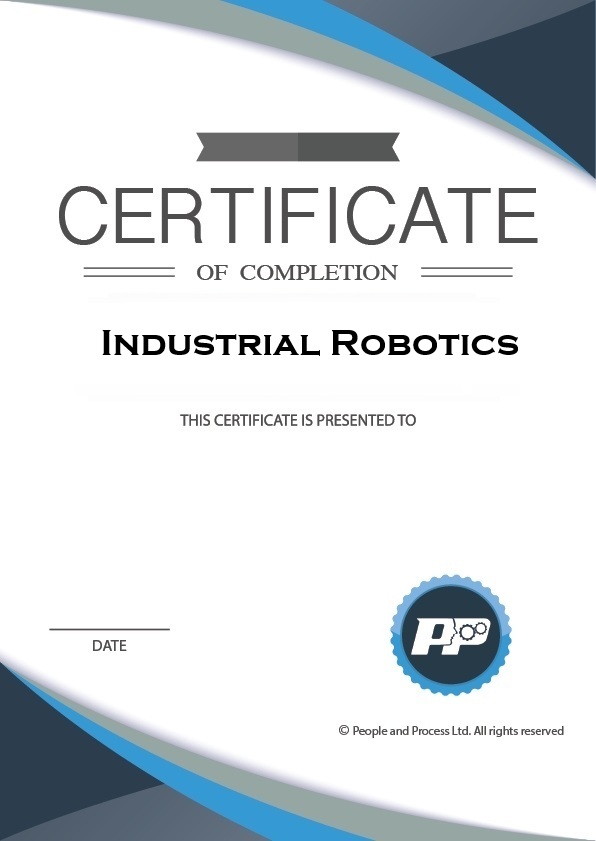
On successful completion of this course all students will be awarded a Certificate of
Completion. This certificate confirms you have completed all the video lessons for
every module and fully met all the requirements of the course.
To achieve this award all the assessment quizzes for each lesson must be passed. The pass grade for each quiz is 80%.You can retake lesson quizzes as often as you like.
The Assessment Method
There’s a quiz at the end of each lesson to test your understanding of the material. To successfully complete this course, you must pass the quiz for each lesson. Once all the lessons have been completed, you can then download and print the People & Process completion certificate.
So let’s get started! In the next lesson entitled “The Need for Good Food Hygiene “, we will look at the requirement for good hygiene practices and how these are implemented.
