
Financial information plays an important role in the successful management of every organisation. Whether you are responsible for a department, a project, a production facility or a service team, understanding the financial implications of your decisions can help you improve performance, control costs and make better use of available resources.
This course is designed for managers, supervisors, team leaders, project managers, production and operations managers, maintenance managers, and other professionals who are responsible for budgets, costs, resources or operational performance but do not have a formal financial background
Learning Outcomes
At the end of this course, you will be able to:
- Explain the importance of financial awareness in effective management and describe how financial information supports business planning and decision-making.
- Identify the purpose and main components of the three principal financial statements: the Income Statement (Profit and Loss), the Balance Sheet and the Cash Flow Statement.
- Distinguish between fixed and variable costs, direct and indirect costs, revenue and profit, and explain how these concepts affect business profitability.
- Explain how budgets and financial forecasts are prepared and used to plan resources, establish financial targets and monitor expenditure.
- Identify practical methods for controlling costs, reducing waste and improving the efficient use of resources within a department or organisation.
- Explain the relationship between profit, cash flow and working capital, and recognise why effective cash management is important to business operations.
- Compare actual financial performance against budget, interpret financial variances and use appropriate financial and operational key performance indicators to assess performance.
- Apply basic financial principles to evaluate expenditure proposals, compare alternative courses of action and support management decisions using financial evidence.
The course is divided into eight lessons.
Lesson 1: Introduction to Finance for Managers
We will explore the role of finance in business, introduce essential financial terminology and examine the importance of financial awareness in everyday management.
Lesson 2: Understanding Financial Statements
We will examine the Income Statement (Profit and Loss), Balance Sheet and Cash Flow Statement, learning how to interpret the information they provide about an organisation’s financial performance and position.
Lesson 3: Understanding Costs and Profitability
We will investigate different types of costs, revenue, profit margins and contribution. We will also introduce break-even analysis and consider how changes in sales volumes and operating costs affect profitability.
Lesson 4: Budgeting and Financial Planning
We will explore how budgets and forecasts support planning, resource allocation and the achievement of financial targets.
Lesson 5: Managing Costs and Resources
We will consider practical approaches to controlling expenditure, improving productivity, reducing waste and making more effective use of people, equipment and materials.
Lesson 6: Cash Flow and Working Capital
We will examine the difference between profit and cash flow, the importance of managing cash inflows and outflows, and how inventory, customer payments and supplier payments influence working capital.
Lesson 7: Financial Performance and Key Performance Indicators
We will learn how to compare actual results against budgets, investigate variances and use financial and operational indicators to identify opportunities for improvement.
Lesson 8: Financial Decision-Making
We will bring together the concepts covered throughout the course to evaluate expenditure proposals, compare alternatives, understand return on investment and make more informed management decisions.
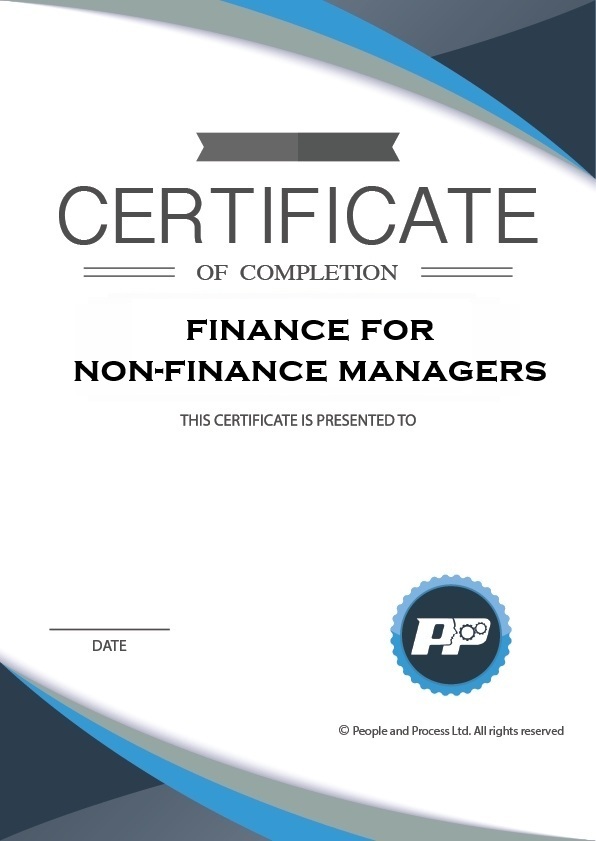
On successful completion of this course all students will be awarded a Certificate of
Completion. This certificate confirms you have completed all the video lessons for
every module and fully met all the requirements of the course.
To achieve this award all the assessment quizzes for each lesson must be passed. The pass grade for each quiz is 80%.You can retake lesson quizzes as often as you like.
The Assessment Method
There’s a quiz at the end of each lesson to test your understanding of the material. To successfully complete this course, you must pass the quiz for each lesson. Once all the lessons have been completed, you can then download and print the People & Process completion certificate.
So let’s get started! In the next lesson entitled “The Need for Good Food Hygiene “, we will look at the requirement for good hygiene practices and how these are implemented.
